Showing posts with label Grade D. Show all posts

Sunday, 22 May 2016

GCSE Bearings revision- Foundation/Higher

There are three important rules to remember when faced with a bearing problem:

  1. Always start from north 
  2. Always turn clockwise 
  3. Write as 3-digits. e.g 035
Bearing problems are often worded: Find the bearing of B from A. This means you need to put your protractor on A and then measure the bearing to B, with zero facing north, going clockwise around your protractor and writing as three digits. 

Here is a video from corbett maths and some practise questions to have a go at.


Exam Questions: 


Thursday, 5 May 2016

Angle Bisectors and Perpendicular Bisectors

Not sure about how to construct a bisector? Or not sure which one is which? Have a look at these two videos which show you the step-by-step instructions.

Angle Bisectors:


Perpendicular Bisectors:


Got the hang of it? Draw a few lines and angles and get some practice in! You'll need a pencil, ruler and compass for this - make sure you have them.

Friday, 29 April 2016

Writing and Solving Equations

You might not have to just solve equations in your exam - you might have to write them out first!

Remember an equation just says that two expressions are equal.

So you just need to write out the information you read, and make sure you include an '=' sign!

Here's an example:

"I think of a number, double it and add seven. My answer is 37.

A number we don't know is usually called x.

Double this number would be written as 2x.

Seven more than this must be 2x + 7.

We are told this equals 37, so we write 2x + 7 = 37.

Got the hang of it? Try writing an equation for each of these sentences:


Tuesday, 26 April 2016

Key Words Explained - 'Product of Prime Factors'

"Write 140 as a product of prime factors."

You've all seen this type of question before, and it's easy to forget what exactly these questions are asking you to do. But if you remember what each word means, you'll know it's asking you to 'split up' the number as far as you can using a factor tree, and then write your answer as a multiplication.

Product: A result of a multiplication
Prime: Only divisible by itself and 1
Factor: A number that divides or 'goes into' it without a remainder

Take a look at the video to brush up on how to answer this type of question.


Got the hang of it? Check your skills by writing these numbers as a product of prime factors:

1) 140

2) 88

3) 180

4) 135

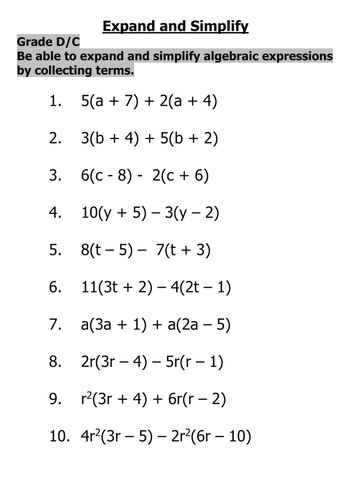
Expanding Brackets - Beware the negatives!!

Always be careful of negatives when expanding brackets!!

Some questions you can have a go at in your own time...


Adding and Subtractions Fractions

If you are struggling to add and subtract fractions this video from Corbett Maths may help. These questions are on the foundation homework. 

nth Term


There are a couple of different ways of finding the nth term. Here's a few examples.